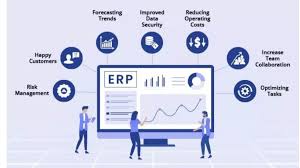
Enterprise Resource Planning (ERP) systems have evolved far beyond their original purpose of centralizing accounting and operational data. In 2026, ERP platforms serve as intelligent digital cores that power automation, analytics, and enterprise-wide decision-making. As organizations prepare for an increasingly data-driven and AI-enabled future, the next phase of ERP innovation is already taking shape.
Here’s a closer look at what the future of Enterprise Resource Planning looks like in 2026 and beyond.
1. AI-Native ERP Platforms
The future of ERP is AI-native, not just AI-enhanced. Modern platforms such as SAP S/4HANA Cloud and Oracle Fusion Cloud ERP are embedding artificial intelligence directly into their core architecture.
In the coming years, AI within ERP systems will:
Predict market demand with high accuracy
Automatically optimize procurement decisions
Detect financial anomalies in real time
Provide prescriptive recommendations to executives
ERP systems will act less like databases and more like intelligent business advisors.
2. Hyperautomation Across Business Functions
Automation will expand beyond routine tasks. The combination of AI, robotic process automation (RPA), and workflow intelligence will create fully automated business processes.
For example, ERP systems integrated with platforms like Microsoft Dynamics 365 will be able to:
Process invoices end-to-end
Approve expenses autonomously
Trigger supply chain adjustments instantly
Generate compliance documentation automatically
Hyperautomation will reduce operational costs and allow employees to focus on innovation rather than administrative work.
3. Composable and Modular ERP Ecosystems
Future ERP systems will move away from rigid, monolithic designs. Instead, enterprises will adopt composable ERP ecosystems where modular applications connect seamlessly through APIs.
Vendors such as Infor and Epicor already offer industry-specific modules that can be deployed independently.
This composable approach enables:
Faster deployment
Lower implementation risks
Greater flexibility
Easier upgrades
Businesses will build ERP environments tailored to their specific operational needs.
4. Cloud Dominance with Hybrid Flexibility
Cloud ERP will continue to dominate due to scalability, lower upfront investment, and continuous innovation. Solutions like SAP S/4HANA now offer both cloud and hybrid deployment options.
Beyond 2026, hybrid ERP strategies will become more common. Enterprises will maintain critical workloads on-premise while leveraging cloud platforms for analytics, AI, and customer engagement.
This blended approach balances innovation with regulatory compliance and data sovereignty requirements.
5. Real-Time Data as a Strategic Asset
ERP systems are becoming real-time operational hubs. Advanced in-memory computing allows organizations to analyze large volumes of data instantly.
Future ERP platforms will provide:
Live financial dashboards
Predictive supply chain analytics
Real-time ESG reporting
Continuous performance monitoring
Executives will rely on ERP-generated insights to simulate scenarios and make faster, data-backed strategic decisions.
6. Stronger Focus on Sustainability and ESG
Environmental, Social, and Governance (ESG) compliance is increasingly mandatory worldwide. ERP systems will integrate sustainability metrics directly into core operations.
Future ERP capabilities will include:
Carbon footprint tracking
Sustainable supplier scoring
Energy consumption monitoring
Automated ESG reporting
Sustainability will no longer be managed in separate systems—it will be embedded into everyday operational processes.
7. Enhanced Cybersecurity and Zero-Trust Architecture
As ERP systems centralize critical enterprise data, cybersecurity will remain a top priority. Leading providers like SAP and Oracle Corporation are investing heavily in advanced security frameworks.
Future ERP security trends include:
Zero-trust architecture
Continuous behavioral monitoring
AI-driven threat detection
Advanced encryption standards
Security will be built into ERP platforms at every level, not added as an afterthought.
8. User-Centric and Conversational Interfaces
ERP user experience will dramatically improve in the coming years. AI-powered digital assistants and conversational interfaces will simplify complex tasks.
Instead of navigating multiple dashboards, users will simply ask questions such as:
“What is our projected cash flow next quarter?”
“Which suppliers have delayed shipments this month?”
ERP systems will respond instantly with data-driven insights, making enterprise software more accessible and intuitive.
9. Deeper Integration with Digital Ecosystems
Future ERP platforms will not operate in isolation. They will seamlessly integrate with CRM, HR tech, e-commerce, IoT devices, and advanced analytics tools.
For example, integration with platforms like Salesforce ensures unified customer and financial data across departments.
Open APIs and low-code integration frameworks will accelerate digital ecosystem connectivity.
10. ERP as a Strategic Innovation Platform
Beyond operational management, ERP systems will serve as innovation platforms. Organizations will use ERP data to:
Identify new revenue streams
Model expansion strategies
Analyze customer profitability
Forecast global market shifts
ERP will become the digital brain of the enterprise—driving strategy rather than merely supporting it.